First up is the Book of Durrow, dating to the middle of the 7th century. The Chi is enlarged, the Rho slightly smaller, the whole line is enlarged and set off and colored yellow. It is n0t really known where the manuscript was made, although it was probably made somewhere in Ireland.
 Durrow is followed by the Lindisfarne Gospels of about 7o0. This is a quantum leap with the Chi Rho dominating the page. The Chi and the Rho are extensively decorated. All of the text on the page is turned into one large decorative pattern. One of my favorite things about the Lindisfarne Gospels is how the artist would "draw" with the decorative red dots found in so many insular manuscripts. Here he has "written" with them to form the letters of the line following the Chi Rho monogram completely out of the red dots. The Lindisfarne Gospels are known to have been produced on the Island of Lindisfarne off the east coast of Northumberland.
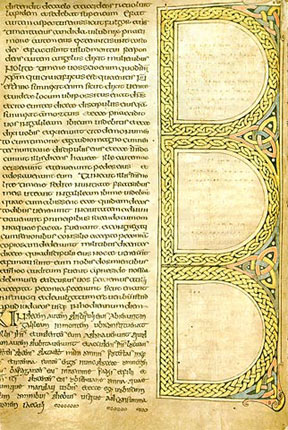
 Next up is an unnamed manuscript in the British Library (Royal MS 1 B VII). This is a smaller scale effort, as this is not as sumptuous of a manuscript. The zoomorphic Chi Rho Initial is as about as large as the initials which begins each of the gospels. The scribe started a new column at the Chi Rho initial, as if he were starting a new work, leaving the bottom of the left column blank. (The text in the obviously different script at the bottom of the left hand column is a later addition, a manumission of a slave in Old English.) This manuscript was produced in the first half of the 8th century in Northumbria.
 Next is the St. Gall Gospels, now housed in the monastery at St. Gall in Switzerland. This manuscript was produced by monks in Ireland about 750 and brought with them when St. Gall was founded. By this point, Chi is taken over the page, leaving room for only a few words of additional text, which is so stylized and decorated as to be unreadable. (This and Lindisfarne are my two favorites.)
 Next up is our friend from last night, the Stockholm Codex Aureus. This is somewhat more restrained, although the text is seen as a decorated pattern with legibility allowed to be lost to aesthetics. This manuscript was produced somewhere in Southumbria, probably Canterbury. The influence of the Roman Church mission at Canterbury probably exerted a restraining influence on the wilder "Celtic" traditions seen in more northern insular manuscripts. This manuscript dates to about 750.
 This one needs no introduction. It is, of course, the Chi Rho page from the Book of Kells and easily one of the most famous manuscript images of the middle ages. Exuberance abounds and there is no restraint. (Despite its fame, I still like Lindisfarne better. Does that make me a heretic?)
This is from another unnamed manuscript in the British Library, (Royal MS 1 B VII). In a sense Kells was at once the culmination and last gasp of the Insular tradition. After Kells the Carolingian Renaissance got underway, and the insular style fell out of favor. The truly deluxe manuscripts of the era looked to classical models. Still some manuscripts were made in the Insular style. This manuscript is from about a century after Kells. Although the Chi Rho monogram is present it is more closely related to the zoomorphic initial of the other unnamed British Library manuscript than to the Durrow, Lindisfarne, St. Gall, and Kells.

This is from the the Bodmin Gospels which was made in the 9th or 10th century. This is not a deluxe manuscript, so, although the Chi is emphasized it is not a major piece of illumination.
 This is from the Book of Deer, which was made in Scotland in the 10th century. One day I will have to talk more about this manuscript in detail. It is a relatively small scale, somewhat odd manuscript, but is clearly still following the Insular tradition.
 This is the Corpus Irish Gospels, now owned by Corpus Christi College, Oxford. It was produced in the twelfth century, almost 500 years after the Book of Durrow. It, along with the next manuscript show the extreme tenacity with which this style had in Ireland. This monogram with its interlace decoration on spiral motifs would be at home in manuscripts centuries older.
My final manuscript is the Gospels of Mael Brigte, which are firmly dated by a colophon to 1138. Although simpler in decoration than the the Corpus Gospels, this manuscript is also done in the insular style, centuries after the style's high point and shows the enduring popularity of the style in Ireland.