Sutton Hoo was one of the greatest archeological finds in the British history. The grave of a 7th century Anglo-Saxon king, excavated in 1939, contained a literal treasure hoard. One of the most impressive pieces was this large gold belt buckle. The main body of the buckle is an intricate mass interwoven animals, executed in chip carving with black niello highlights. The overall design is symmetrical although the details of interlacing are not. The main plate is hollow and has a hinged back, forming a secret compartment.
Showing posts with label Anglo-Saxon. Show all posts
Monday, December 13, 2010
Sutton Hoo Buckle.
Sutton Hoo was one of the greatest archeological finds in the British history. The grave of a 7th century Anglo-Saxon king, excavated in 1939, contained a literal treasure hoard. One of the most impressive pieces was this large gold belt buckle. The main body of the buckle is an intricate mass interwoven animals, executed in chip carving with black niello highlights. The overall design is symmetrical although the details of interlacing are not. The main plate is hollow and has a hinged back, forming a secret compartment.
Tuesday, March 30, 2010
Stockholm Codex Aureus
It's been a long while since I posted anything here, but I'm back, at least for the moment.
This is the Stockholm Codex Aureus (Stockholm, Royal Library, MS A. 135), also known as the Codex Aureus of Canterbury. "Codex Aureus" can be translated as "Golden Book" and refers to the liberal use gold leaf used in the decoration of this manuscript. There are several other manuscripts known as the Codex Aureus as well, so you have to specify which one you are dealing with. Stockholm refers to its current location, while Canterbury refers to where it was probably made.
This is a Gospel Book and contains the Latin text of the four gospels. (I'm not sure what version, but I would bet that it is the mix of Vulgate and Vetus Latina found in other insular gospels). I also don't know what texts, other than the Gospels it contains, although I do know that it has Canon Tables. I would assume that some of the prefatory matter found in other Insular Gospels is present. There are 193 extant folios. Alternating folios have been dyed purple. The text is written in an uncial script in black, white, red, gold and silver inks. There are two surviving evangelist portraits, six decorated canon tables and seven decorated initials.
The portrait of Matthew shown here, is quite different from the highly stylized and abstracted portraits in other Insular manuscripts. Matthew is seated on throne within an arcade with pillars. Curtains hanging from above are wrapped around the pillars. In the tympanum above is his symbol, the winged man. There is little in the way decoration and the composition lacks the elaborate decorated borders found in some of the other insular manuscripts. Although the elements, including Matthew himself, are stylized and flattened the entire composition has a serene monumental quality. In many ways, this can be seen as a precursor to later Anglo-Saxon and Carolingian styles.
The facing text page, however, would be comfortably at home in any of the great Insular manuscripts like Kells or Durrow. The text block and each line of text is contained within a frame. The text lines alternate between a gilded background and golden letters, creating a dazzling effect. The opening initial is an elaborate monogram decorated with interlaced patterns and laid on a background of spiral motifs. As can be seen by the detail below, the draftsmanship is quite high.
That the evangelist portrait faces this page is quite interesting. The initial monogram is of the Greek letters Chi and Rho (XP). This monogram was often used as in place of the word for "Christ". The interesting thing is that, although evangelist portraits were usually placed at the beginning of a gospel, this is not the beginning of the Gospel of Matthew. This is the text which begins at Matthew 1:18. The preceding 17 verses contain a genealogy of Christ, and the actual narrative of Christ's life starts here. In insular manuscripts, the genealogy was often treated almost as a separate work and this "second beginning" was often given its own frontispiece, although this is the only manuscript that I am aware of that moves the evangelist portrait here. The enlarged, decorated Chi Rho monogram at this point in the text is a motif that is limited to insular gospel books.
This manuscript was at Christ Church, Oxford in the 9th century. It was looted by the Vikings, ransomed by Earl Alfred (later King Alfred). At some time in the middle ages it was lost again. It was found by a Swede in 1690 in Spain and purchased for the Swedish Royal Library
This is the Stockholm Codex Aureus (Stockholm, Royal Library, MS A. 135), also known as the Codex Aureus of Canterbury. "Codex Aureus" can be translated as "Golden Book" and refers to the liberal use gold leaf used in the decoration of this manuscript. There are several other manuscripts known as the Codex Aureus as well, so you have to specify which one you are dealing with. Stockholm refers to its current location, while Canterbury refers to where it was probably made.This is a Gospel Book and contains the Latin text of the four gospels. (I'm not sure what version, but I would bet that it is the mix of Vulgate and Vetus Latina found in other insular gospels). I also don't know what texts, other than the Gospels it contains, although I do know that it has Canon Tables. I would assume that some of the prefatory matter found in other Insular Gospels is present. There are 193 extant folios. Alternating folios have been dyed purple. The text is written in an uncial script in black, white, red, gold and silver inks. There are two surviving evangelist portraits, six decorated canon tables and seven decorated initials.
The portrait of Matthew shown here, is quite different from the highly stylized and abstracted portraits in other Insular manuscripts. Matthew is seated on throne within an arcade with pillars. Curtains hanging from above are wrapped around the pillars. In the tympanum above is his symbol, the winged man. There is little in the way decoration and the composition lacks the elaborate decorated borders found in some of the other insular manuscripts. Although the elements, including Matthew himself, are stylized and flattened the entire composition has a serene monumental quality. In many ways, this can be seen as a precursor to later Anglo-Saxon and Carolingian styles.
The facing text page, however, would be comfortably at home in any of the great Insular manuscripts like Kells or Durrow. The text block and each line of text is contained within a frame. The text lines alternate between a gilded background and golden letters, creating a dazzling effect. The opening initial is an elaborate monogram decorated with interlaced patterns and laid on a background of spiral motifs. As can be seen by the detail below, the draftsmanship is quite high.
That the evangelist portrait faces this page is quite interesting. The initial monogram is of the Greek letters Chi and Rho (XP). This monogram was often used as in place of the word for "Christ". The interesting thing is that, although evangelist portraits were usually placed at the beginning of a gospel, this is not the beginning of the Gospel of Matthew. This is the text which begins at Matthew 1:18. The preceding 17 verses contain a genealogy of Christ, and the actual narrative of Christ's life starts here. In insular manuscripts, the genealogy was often treated almost as a separate work and this "second beginning" was often given its own frontispiece, although this is the only manuscript that I am aware of that moves the evangelist portrait here. The enlarged, decorated Chi Rho monogram at this point in the text is a motif that is limited to insular gospel books.
This manuscript was at Christ Church, Oxford in the 9th century. It was looted by the Vikings, ransomed by Earl Alfred (later King Alfred). At some time in the middle ages it was lost again. It was found by a Swede in 1690 in Spain and purchased for the Swedish Royal Library
Labels:
8th Century,
Anglo-Saxon,
Gospel Books,
Insular manuscripts,
Manuscripts
Wednesday, April 9, 2008
The Caligula Troper
This is a page from the Caligula Troper (British Library, MS Caligula A XIV). A troper is a collection of tropes, which were new music inserted into the chants of the mass for special feast days. This book was intended to be used by a soloist, and was of a small scale. The opulence of the decoration indicate that it was made for an important patron. The tropes included in the manuscript indicate that it may have been made in Winchester or Worcester. It was made in about 1050. This page has an image of the Wise Virgins (Matthew 25:1-13) as an illustration for the mass for Virgin Saints. The Virgins hold the lamps and torches from the parable, along with branches, which may represent the the palms of martyrdom. The Hand of God blesses them from above. The Virgins' robes are abstracted into a geometric pattern and the are placed against a gold background which gives an unworldly, spiritual feel to the illustration.The manuscript names comes form its position in the Cotton Library. Robert Cotton was a 17th century bibliophile. He kept his manuscripts in case above which were busts of Roman emperors and Ladies. These busts were used to Catalog the manuscripts. This manuscripts shelfmark, Caligula A XIV meant that the manuscript was in the case under the bust Caligula, on the first shelf, and 14th book from the left. When the Cotton Library became one of the foundational collections of the British Library, its shelfmarks were retained.
Labels:
11th Century,
Anglo-Saxon,
Manuscripts,
Troper,
Wise Virgins
The Fuller Brooch
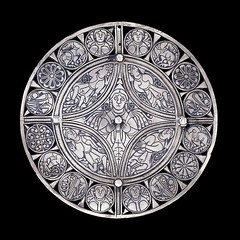
For a change of pace, I thought I would not do a manuscript today. This is the Fuller Brooch, a piece of 9th century Anglo-Saxon jewelry. It may be the only piece of secular Anglo-Saxon metal work to survive above ground. (All other secular pieces have been found as part of treasure hoards. Some religious pieces survived in churches.) Years ago, when I first started at Wikipedia, I wrote my first article about this brooch. To quote what I said there:
The Fuller Brooch is a large disc made of hammered sheet silver inlaid with black niello and with a diameter of 11.4 cm. Its center roundel is decorated with personifications of the five senses. In the center is Sight with large staring oval eyes, surrounded by the other four senses, each in his own compartment. Taste has a hand in his mouth. Smell's hands are behind his back, and he stands between two tall plants. Touch rubs his hands together. Hearing holds his hand to his ear. This is the earliest known representation of the five senses. In the outer border are human, bird, animal and plant motifs.
Labels:
9th Century,
Anglo-Saxon,
Brooch,
Five Senses,
Metalwork
Subscribe to:
Posts (Atom)